Here are the steps your team can follow when brainstorming the structure of the UAV.
Step 1:
Fixed-wing UAVs or Rotorcrafts?
- What is the operation scenario of the UAV?
- Limitations on takeoff and landing sites?
- Requirements on flight time and distance?
- Payload restrictions?
- Rotorcrafts
- Pros
- Flexibility & Maneuverability (hover, vertical takeoff and landing (VTOL))
- Easy operation
- Portable
- Easy to install, disassemble, and repair
- Mature techniques at present
- Cons
- Not suitable for long-journey missions
- Very limited load weight, small internal space
- Relatively low speed
- Pros
- Fixed-wing UAVs
- Pros
- Suitable for long-journey missions
- Can achieve high speed
- Better aerodynamic performance
- Less energy consumption (electrical batteries)
- Large payload capacity, large internal space
- Cons
- Strict takeoff and landing runway limitations
- Weak flexibility, cannot manage missions like accurate mapping
- Complex operation
- Pros
Plus, sometimes, hybrid drones can be the optimal option.
Step 2:
Analyze the Layout/ Configuration
Fixed-wing
- Straight wing
- Pro: structure simple; lightweight; large lift
- Con: large drag and unstable under high-speed
- Applications: model aircraft; (early) subsonic aircraft
- Delta wing
- Pro: little drag; large fuel tank; lightweight
- Con: poor maneuverability under low speed; difficult to land
- Applications: High-speed aircraft
- Trapezoidal wing
- Pro: structure simple; large lift; high structural strength
- Con: limited wingspan
- Applications: Low-speed aircraft
- Flying wing
- Pro: high aerodynamic efficiency
- Con: difficult to manipulate; poor stability
- Applications: Fighters
- Forward-swept wing
- Pro: good low-speed performance; large lift; high wing aerodynamic efficiency
- Con: prone to bending and deformation; relatively complex structure; requires higher material quality and manufacturing costs
- Applications: Fighters
- Swept wing
- Pro: little drag; suitable for high-speed flight
- Con: poor low-speed performance (little life)
- Applications: high-speed aircraft
Rotary wing
- Single-rotor
- Pros:
- Simple structure, easy maintenance
- Longer flight endurance
- Capable of carrying heavier payloads
- Better stability in strong winds
- Cons:
- Noisy due to large rotor
- Large rotor poses safety risks
- Complex design requiring tail rotor for stabilization
- Applications:
- Agricultural spraying
- Transporting heavy loads
- Long-duration surveillance missions
- Pros:
- Dual rotor
- Pros:
- Vertical take-off and landing (VTOL) capabilities, offering helicopter-like flexibility
- Fixed-wing efficiency during high-speed flight
- Superior performance in range and speed
- Cons:
- Complex design and manufacturing, higher maintenance cost
- Potential instability during mode transitions
- Requires advanced piloting skills
- Applications:
- Military reconnaissance and transport (e.g., V-22 Osprey)
- Search and rescue missions
- Long-range cargo transport
- Pros:
- Multirotor
- Pros:
- Easy to control, ideal for hovering and precise flight
- Relatively simple structure, lower cost
- Can operate in tight spaces
- Cons:
- Short flight endurance, limited payload capacity
- Less stable in strong winds
- Slower flight speeds
- Applications:
- Aerial photography and videography
- Surveying and mapping
- Package delivery
- Pros:
Step 3:
(Fixed-wing) Wing Position
- High-wing: Wing positioned above the fuselage
- Pro: high stability; good runway adaptability; little drag; large fuselage capacity; wide vision (camera position)
- Con: poor flexibility; large drag; complex structure
- Mid-wing: Wing positioned in the middle of the fuselage
- Pro: little drag; high flexibility and maneuverability
- Con: limited fuselage space (wing box occupies volume)
- Low-wing: Wing positioned below the fuselage
- Pro: high flexibility; easy-to-place landing gears
- Con: relatively low stability; limited fuselage space (wing box occupies volume); not suitable for low-altitude flights
Step 4:
Tail Design
Here are some major types of tails, and the common ones are discussed in the following:
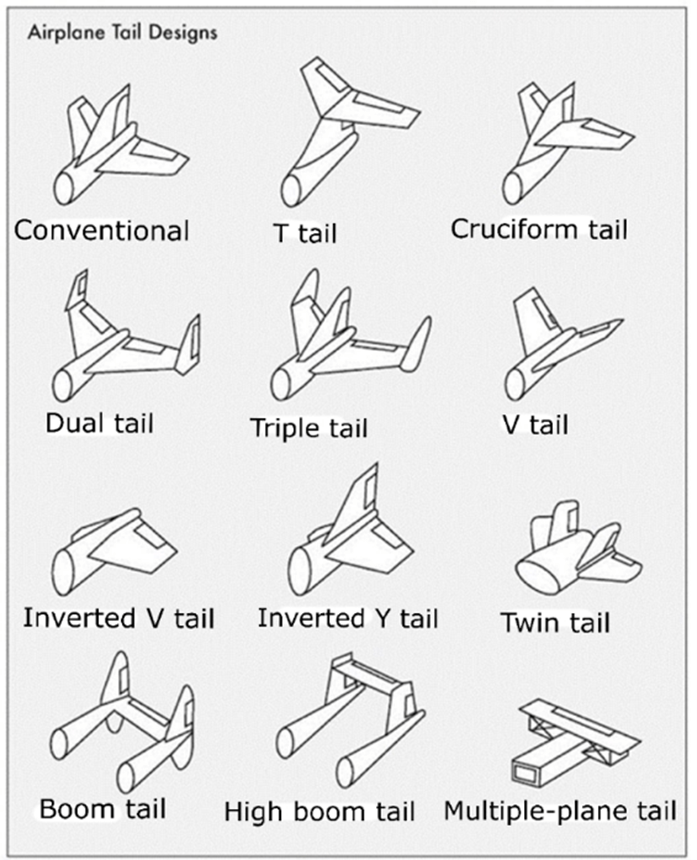
- Conventional tail
- Pros:
- High structural stability and reliability
- Avoid wing wake flow interference
- High control efficiency
- Easy fuselage rear opening, easy for cargo loading and unloading
- Cons:
- Require high material strength and lightweight
- Special aeroelastic problems exist
- Pros:
- V tail
- Pros:
- Improves the aircraft’s control performance and longitudinal stability under high-speed
- Helps reduce drag and increase speed
- May serve the functions of both the vertical and horizontal stabilizers
- Cons:
- Complex design with high material requirements
- May generate additional aerodynamic drag in certain flight conditions
- Pros:
 UAV Design Training